The Crimson Thread Part 3: Gospel Hope From Exodus to Malachi
Note: This is part 3 of our series, The Crimson Thread: Tracing the Gospel From Genesis to Revelation. Click here to begin with Part 1: The Miracle of The Bible
The Gospel Thread Continues
The Old Testament, a tapestry of history, poetry, apocalypsis, and prophecy, lays the foundation for the arrival of Jesus Christ and the Gospel. Its varied books and genres consistently point to the coming Messiah, His sufferings, and His ultimate triumph. In Part 2 – Jesus in Genesis, we saw how the promise of the gospel was given from the beginning of the fall of man. In this third article we continue to explore key events and prophecies that foreshadow Christ and the salvation He brings.
Moses and the Passover
The Passover, instituted in Exodus 12, is a profound symbol of Christ’s sacrificial death. The blood of the lamb, which protected the Israelites from the angel of death, points to Jesus, the Lamb of God, whose blood redeems from sin and death. The Israelites were enslaved in Egypt, but God delivered them through the Passover and the Exodus. In the New Testament, Jesus provides a greater deliverance—not from physical slavery, but from sin and spiritual bondage. Paul draws this parallel in 1 Corinthians 5:7, saying, “Christ, our Passover lamb, has been sacrificed.”
In 12:2 we read: “This month shall be your beginning of months; it shall be the first month of the year to you”. The month of Passover then became the first month of the new year for Israel. It was to be a festival that would mark the start of a new year and a new life for Israel. Even as the Passover lamb was a type of Christ, His coming marks the change of our world. Even so His coming into our lives marks the beginning of a new life for God’s children.
In v.5, God says: “Your lamb shall be without blemish”. This reminds us of what 1Peter_1:19-20 tells us more than a thousand years later: “… but with the precious blood of Christ, as of a lamb without blemish and without spot. He indeed was foreordained before the foundation of the world”. Also, no bone of the Passover lamb was to be broken – even as Jesus’ legs were not broken, as was the practice at the time He was crucified.
The Bronze Serpent
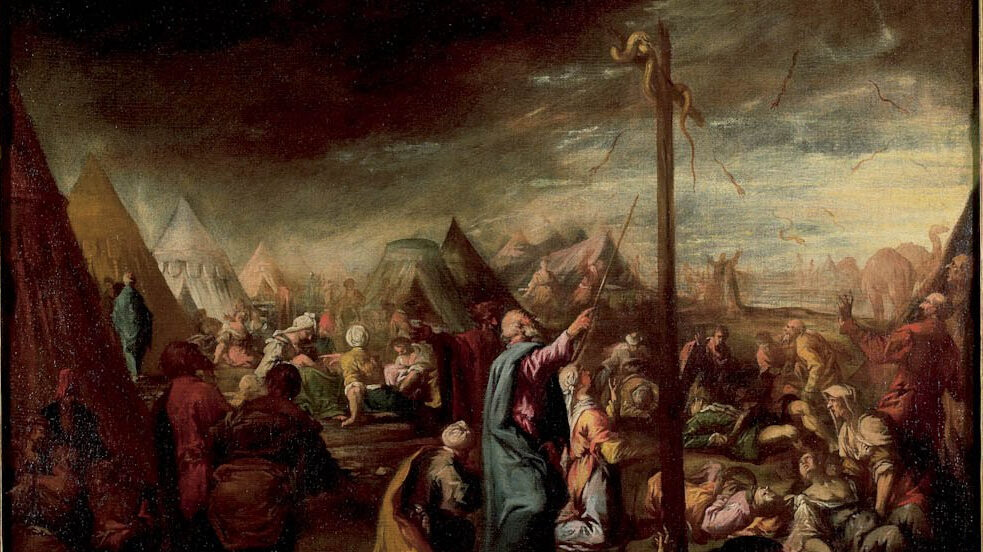
During their wilderness journey, the Israelites rebelled against God and Moses for bringing them out of slavery in Egypt, saying that they hated the “worthless bread” that was regularly given from heaven. God then sent fiery serpents to bite them, and many died. When they realized that they had sinned, they asked Moses to pray for them, which he did. God then instructed Moses to make a bronze serpent and hang it on a pole; whoever is bitten and looks at it, is healed. This act prefigures Jesus’ crucifixion, as He Himself states in John 3:14-15 that He will be lifted up, and that all who look upon Him in faith, will have eternal life.
Just as the bronze serpent was lifted up on a pole, Jesus was lifted up on the cross, drawing all who believe in Him to salvation. In John 12:32, Jesus declares: “And I, when I am lifted up from the earth, will draw all people to Myself.”His liftinf up also signifies glorification and victory – His death was not just a punishment, but the ultimate triumph over sin and death.This event fits perfectly into the broader context of God’s plan for salvation. This serpent was indeed a foreshadowing of Jesus on the cross.
David’s Eternal Throne
God’s covenant with David in 2 Samuel 7:12-16 promises that David’s throne will be established forever. “I will establish the throne of his kingdom forever… Your house and your kingdom will endure forever before me; your throne will be established forever.” (2 Samuel 7:12-16). This prophecy foretells an everlasting dynasty, which was partially fulfilled in David’s descendants but ultimately fulfilled in Christ, who reigns eternally.The New Testament repeatedly identifies Jesus as the Son of David, linking Him directly to this eternal throne:
Matthew 1:1 – The genealogy of Jesus begins: “Jesus Christ, the son of David, the son of Abraham.”
Luke 1:32-33 – The angel tells Mary: “The Lord God will give Him the throne of His father David, and He will reign over Jacob’s descendants forever; His kingdom will never end.”
Romans 1:3 – Paul affirms: “Jesus Christ our Lord, who was descended from David according to the flesh.”
Revelation 22:16 – Here, in the last chapter of the Bible Jesus, the Victor over all, announces: “I, Jesus, have sent My angel to testify to you these things in the churches. I am the Root and the Offspring of David, [I am] the Bright and Morning Star.”
Messianic Prophesies in the Psalms
Psalm 22: The Suffering Messiah
Psalm 22 vividly describes the suffering of the Messiah: “My God, my God, why have you forsaken me?” These words, echoed by Jesus on the cross, highlight His agony and fulfillment of this prophecy.
Psalm 110: The Priestly King
Psalm 110 portrays the Messiah as a priest forever, in the order of Melchizedek. Now you may wonder what this means. Let me explain…
Genesis 14 is the only text in Scripture that mentions any incident involving Melchizedek, “the priest of the most high God”. There is no record in the Bible that gives us his (human) ancestry, nor his posterity. Additionally, he was not only a priest, but also king of Salem (meaning “peaceful”). Exceptional, don’t you think? The normal priesthood that God had commanded in the Old Testament, had to be held only by a Levite, according to the order of Aaron. They had forebears, and a posterity, they inherited the priesthood, they lived, died and were replaced by the next generation of Levites. Not so Melchizedek. Yet he was a priest of the most high God. How do we understand this?
You see, Melchizedek was a shadow of Jesus Christ, who did not have a human father, was not a Levite, and had no predecessor or replacement. And He is indeed the “Prince of Peace”, even as Melchizedek was the “king of Salem”. Therefore, He is “Priest forever according to the order of Melchizedek.” (Psalm 110:4, and Hebrews 5:6)
Hebrews 5 and 7 explain this very clearly. I’m hoping that you will make time to read it. Really enlightening! So, Jesus’ priesthood is as unique as that of Melchizedek, and eternal, bringing reconciliation between God and humanity.
Isaiah’s Vision of the Messiah
The Virgin Birth
Isaiah prophesies the miraculous birth of the Messiah: “Therefore the Lord himself will give you a sign. Behold, the virgin shall conceive and bear a son, and shall call his name Immanuel.” (Isaiah 7:14) Directly translated from Hebrew, the name Immanuel means: “God is with us”. This prophecy is fulfilled in Jesus, as recorded in the Gospels. He is indeed God, who dwelt among us in human flesh. (See John 1:1, 14).
The Prince of Peace
Isaiah announces the coming of the Messiah with titles such as Wonderful Counselor, Mighty God, Everlasting Father, and Prince of Peace in Isaiah 9:6-7. These titles encapsulate the nature and mission of Jesus. In time, we will encounter many more complexities that man could not have imagined. This reminds me of what Isaiah 55:8- 9 tells us: “For My thoughts are not your thoughts, nor are your ways My ways,” says the LORD. For as the heavens are higher than the earth, so are My ways higher than your ways, and My thoughts than your thoughts.” God has indeed wonderful ways in which He demonstrates His thoughts, wisdom, and might.
The Suffering Servant
This Scripture contains the most detailed prophecies concerning the Messiah’s suffering and sacrificial death in Isaiah 52:13–53:12. Describing the Servant who bears our sins and is wounded for our transgressions, this passage depicts Jesus’ redemptive work on the cross. Remember that Isaiah wrote this prophecy approximately 700 years before Jesus’ crucifixion.
Daniel’s Prophetic Visions
The Son of Man
Daniel’s vision of the “Son of Man” coming with the clouds of heaven in Daniel 7:13-14 is a powerful Messianic image. Jesus frequently called Himself the Son of Man, linking His mission to this prophecy.
The Anointed One
The seventy-week prophecy in Daniel 9:24-27 foretells the coming of the Anointed One, who will end sin and usher in everlasting righteousness. This timing aligns with Jesus’ ministry and sacrificial death. For the sake of interest I would point out that the “Anointed One” is translated from the New Testament Greek as “Christos” (from which comes our English “Christ”) and from the Old Testament Hebrew “Messiah”. This comfortably gives us the term, “Jesus, the Christ”.
The Seventy-week Prophecy
The seventy-week prophecy in Daniel 9:24-27 is one of the most precise Messianic timelines, predicting the arrival of the Anointed One. The prophecy outlines a period leading to the Messiah’s first appearance, His atoning sacrifice, and the end of the old sacrificial system. Jesus fulfilled this prophecy by bringing reconciliation for iniquity and ushering in everlasting righteousness through His death and resurrection. The prophecy also foretells the destruction of Jerusalem and the Temple, which occurred in 70 AD. This vision underscores Jesus as the culmination of God’s redemptive plan, establishing a spiritual kingdom that will never be destroyed.
Jesus’ Return
Daniel’s prophetic visions provide a remarkable blueprint for the coming of Jesus Christ, revealing His divine authority, redemptive mission, and eternal reign. The Son of Man in Daniel 7:13-14 is depicted as approaching the Ancient of Days, receiving glory, dominion, and an everlasting kingdom. Jesus directly claimed this prophecy during His trial in Mark 14:61-62, declaring, “You will see the Son of Man sitting at the right hand of the Mighty One and coming on the clouds of heaven.” This statement affirmed His Messianic identity, leading to His condemnation by the religious leaders. The imagery of coming with the clouds signifies divine authority, as seen in Revelation 1:7, where Jesus is described as returning in glory.
Other Prophets
Jeremiah and the New Covenant
In Jeremiah 31:31-34, God promises a new covenant, unlike the old covenant made with Israel’s ancestors. This new covenant, written on hearts, is realized through Jesus Christ and His Gospel, offering a relationship with God based on grace and forgiveness. Colossians 2:9-11 sums this up beautifully.
That reminds me: God being willing, our next look will be the (old) covenant that God made with Abraham and his posterity.
Ezekiel and the Shepherd
Ezekiel 34:23-24 speaks of God raising up a shepherd like David to care for His people. Jesus identifies Himself as the Good Shepherd, fulfilling this prophecy by gathering and nurturing His flock. It reminds me also of the beautiful parable in Luke 15:3–7. Jesus tells the story of a shepherd with 100 sheep, but when one goes missing, he leaves the 99 to search for the lost one. When he finds it, he joyfully carries it home on his shoulders and calls his neighbors to celebrate its return.
This parable illustrates God’s deep love and relentless pursuit of the spiritually lost. It emphasizes that every individual matters, and there is great joy in heaven when even one sinner repents and returns to God. Ezekiel spoke this prophecy about 600 years before Jesus was even born.
Micah: The Birth in Bethlehem
Micah 5:2 predicts that the Messiah will be born in Bethlehem: “But you, Bethlehem Ephrathah, [meaning in the district/area of Ephrathah] though you are small among the clans of Judah, out of you will come for me one who will be ruler over Israel.” Jesus’ birth in Bethlehem fulfills this prophecy.
And here is the pleasant surprise for you: The name “Bethlehem” is made up from 2 Hebrew words: “bah’-yith” (meaning house) and “lekh’-em” (meaning bread). The combination of these two words gives us “Bethlehem”, meaning “House of Bread”! Isn’t that wonderful!? He was indeed born in Bethlehem, the house of bread, exactly as Micah had foretold, about 650 years before Jesus was born. Accordingly, Jesus said, in John 6:35: “I am the bread of life. He who comes to Me shall never hunger, and he who believes in Me shall never thirst.”
Zechariah: Jesus’ Entry into Jerusalem
About 500 years before the birth of Jesus Christ, Zechariah 9:9 prophesied the Messiah’s triumphant entry into Jerusalem on a donkey. He wrote: “Rejoice greatly, O daughter of Zion! Shout, O daughter of Jerusalem! Behold, your King is coming to you; He is just and having salvation, lowly and riding on a donkey, a colt, the foal of a donkey.” The Gospels recount Jesus’ entry into Jerusalem, fulfilling this prophecy.
Yet another part of our “jigsaw puzzle” falls into place!
Malachi: The Forerunner
Malachi 4:5-6 foretells the coming of Elijah “before the great and dreadful day of the Lord”. John the Baptist, who comes “in the spirit and power of Elijah” (Luke 1:17), prepares the way for Jesus, fulfilling this prophetic expectation. Eventually, we will get to discuss exactly how John prepared the way for Jesus’ first coming.
Conclusion
The Old Testament contains multiple events (“shadows”) and prophecies that point to Jesus Christ and the Gospel. From the earliest books of Genesis to the final prophecies of Malachi, the Messianic thread weaves through scripture, culminating in Jesus’s life, death, and resurrection. This continuous line underscores the divine orchestration of salvation history and the fulfillment of God’s redemptive plan through Jesus, the Christ.
Can you now see how miraculously the Bible that God has given in our hands, is put together, telling the same story from different angles? God willing, I will try to “lift the veil,” some more, as we might call it, in our continued articles.
Continue to Part 4…
Read the next article in our Series: The Crimson Thread: Part 4